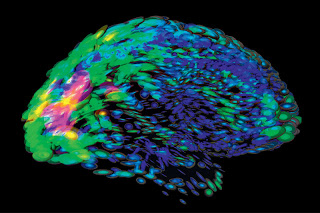
The study, a collaborative effort between Johns Hopkins and the University of Alabama at Birmingham, included data from 72 autism and control brains. It was published online last week in the journal Nature Communications.
“There are many different ways of getting autism, but we found that they all have the same downstream effect,” says Dan Arking, an associate professor in the McKusick-Nathans Institute for Genetic Medicine at the Johns Hopkins University School of Medicine. “What we don’t know is whether this immune response is making things better in the short term and worse in the long term.”